

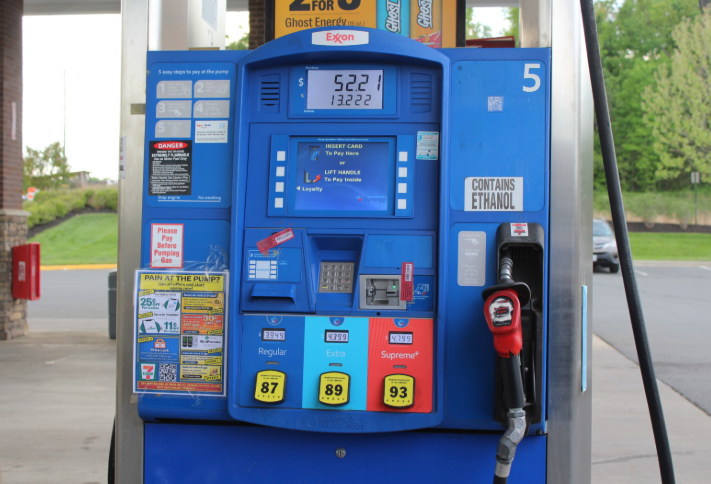
From skyrocketing gas prices to the cost of everyday food items, the Iran war has had a tremendous impact on this country and the average American.
This war started on Feb. 28, 2026, when the U.S. and Israel conducted a joint military operation against Iran. The justification for these strikes was that Iran’s ballistic missile program was dangerous and posed a threat to America and its allies.
The war has resulted in several Iranian casualties, including both military and civilians. Reports show over 3,000 people dead in Iran alone, as well as many more scattered throughout the Middle East.
Some may believe that this war doesn’t directly affect the U.S. because there have been no strikes on American soil. However, this is easily refuted by the shift in America’s economy.

The most substantial effect is the rise in oil and gas prices in America. On Mar. 4, 2026, Iranian officials announced the closure of the Strait of Hormuz, which is a waterway where about 27% of the world’s crude oil and petroleum products transit. Due to this shutdown, America lost access to a percentage of its oil shipments, causing higher gas prices for American citizens.
According to Michelle Cooper, a history teacher at Patriot High School, “We live in a global market where any destabilization impacts us.”
The closing of the Strait may seem unrelated to America and how we get our oil, but in reality, it plays a big role in the average gas prices we see every day.
From the start of the war, gas prices went up $1.16 a gallon. Additionally, there has been an increase in spending at gas stations of 16.5%, and the average cost of gas is about $4 per gallon. This compares to the standard before the war, which was set at $2.98.

Rida Hashmi (‘27), a student and driver from Patriot High School (PHS), speaks on how the Iran war has affected her gas prices, “It was about $45, and now it’s at least $60 or $70.”
Regarding changes on daily life due to the heightened prices, she states, “I do think about if I should actually go places that I want to. . . if it’s worth it or not.”
In fact, survey data collected from a portion of student drivers at PHS demonstrates that 45% of people spend 60 to 80 dollars on a full tank of gas since the beginning of the war. In addition, 64% of drivers have an overall negative opinion regarding the war.
As the war continues, the current status of the Strait remains irresolute, with both the U.S. and Iran conducting naval blockades and intercepting ships in the waterway.
However, the rise in oil prices is not the only known impact; America is set to see an increase in grocery prices as well. According to the U.S. Department of Agriculture, the price of food is predicted to increase 2.9% in 2026.
There are many factors that go into food production, such as energy, fertilizer and shipping. Due to the war, shipping costs will rise with oil prices. Additionally, the cost of fertilizer, which is typically created from natural gas, will also increase. The impact on supply chains is what will ultimately affect American consumers.
Cooper states that “It’s like a snowball effect. Once gas and oil go up, everything will follow.”
The American people’s view on this war has been mainly negative, with about 61% opposing the handling of the conflict. Even many Republican lawmakers have condemned President Donald Trump’s actions in Iran. Many have stated that they do not support the conflict or the presidents threats against the Iranian people.
Cooper says, “There’s more and more people who are questioning the goals and objectives of the war.”
Along with rising prices, the Iran war has large political ramifications. The upcoming mid-term elections, happening this November, will elect new members for Congress. However, the vast public disapproval of this war may cost numerous Republicans the win during the election.
Overall, while there has been no direct physical impact on Americans, the economic and political effects of this war are clear. It influences the lives of Americans across the nation and will continue to do so much after its end.

![A picture of a soccer ball on the floor taken on Wednesday, Feb. 11, 2026 [Granaz Nabi Bakhsh]](https://phscharge.com/wp-content/uploads/2026/02/Granaz-Photo.png)
![Photo of Patriot High School students water bottles that were bought during different periods of time, each to when they were trending. [Marina Georgy]](https://phscharge.com/wp-content/uploads/2026/02/recession-2.png)