

You’ve definitely heard it at least once, probably while scrolling on social media: “I miss 2016!”
2016 in the United States was a year of music, fashion, iconic celebrities, peak social media and more. That being said, it wasn’t the best year. In fact, many people call it the worst year ever.
2016 – The Worst Year?
One of the main reasons people claim 2016 to be so awful was the American political polarization that became more intense following the presidential election, leading to a disconnection of the American community.
Additionally, many devastating events took place in 2016, such as the Orlando nightclub shooting which was thought to be America’s worst terror attack since 9/11, the shooting of a Cincinnati Zoo gorilla named Harambe which sparked massive debate and controversy, high police brutality rates, and the “clown incidents.”
Reminiscence Bump
As most nostalgia for 2016 comes from the media, it brings up a phenomenon known as the reminiscence bump, which is where people tend to recall teenage memories more vividly and positively.
The main portion of people currently using modern popular social media apps fit the age demographic of 18-29, making their opinions the loudest. This means that, in 2016, they were around the teenage-young adult age range. As memories are encoded more intensely around those ages, it makes sense why this specific age group would reminisce about 2016 so frequently.
However, as they express 2016 nostalgia on the media, younger generations online are influenced to adopt the same mindset. This likely caused the spread of 2016 reminiscence, and though younger generations may not remember it, what they have heard through influencers or posts on the internet is undoubtedly enough to influence their perception on that year.
Then vs. Now
2016 wasn’t all bad. It was the last year that was considered “normal,” before political polarization skyrocketed in the following years as well as the COVID-19 pandemic. Since COVID-19, America has been filled with increased economic/income uncertainty, unemployment and underemployment pressure, online toxicity, and general recovery from the pandemic. That being said, compared to later years, 2016 was not all that awful, and this leads to the year being associated with more freedom and joy.
The icons of 2016 notably included Ariana Grande, Justin Timberlake, and Kylie Jenner, among many others. Kylie Jenner recently brought back her 2016 lip kits as well as her King Kylie persona, which was characterized by brightly colored hair and grungy style, for the 10-year anniversary of her brand Kylie Cosmetics.
Aesthetics were livelier in 2016, with fashion items such as jeggings, skinny jeans, and color-shoulder tops, as well as accessories such as rainbow loom and chokers dominating the fashion scene.
In a survey that analyzed the responses of 26 Patriot High School students, students listed beachy aesthetics, EOS lip balm, prime YouTube creators, palm trees, polaroid music and the Snapchat dog filter among others to be the most prevalent indicators of 2016.
Additionally, one student said “Everyone was happier in 2016, and they were all expressing [themselves]. But now, when you [look] around [in 2025], you see almost everyone look the same in terms of clothing and hair.”
Internet Culture
Internet culture has changed drastically since 2016. Due to the increased prevalence of short form content platforms like TikTok, Instagram Reels, and YouTube Shorts, trend cycles evolve and die down extremely fast.
Memes of today go in faster trend cycles, making them more exaggerated, annoying, niche, and low-quality. They evolve over hours or days, in contrast to the weeks or months it used to be drawn out to.
You’ve probably heard of the term “brain rot,” which Oxford named the “Word of 2024”. As defined by Merriam-Webster, brain rot is “[media] of low or addictive quality, typically in online media, that preoccupies someone to the point it is said to affect mental functioning.”
Brain rot has become increasingly popularized as a result of these short form content platforms, which is associated with doomscrolling, zombie scrolling, and social media addiction. Over time, this causes emotional desensitization, cognitive overload, and negative self-concept among other effects.
People online are currently talking about the “great meme reset,” which proposes bringing back memes from the past decade before they became low-quality. Classic memes from the 2000’s and 2010’s have been seeing a gradual resurgence in the hopes that declining humor can reverse.
Two apps that were popularized in 2016 for their humorous appeal were Musical.ly and Vine, serving as lip-syncing and short form content apps respectively. Musical.ly merged with TikTok in 2017 after being acquired by TikTok’s parent company, ByteDance.
Vine was known to foster internet comedy and launch creator careers, as well as serve as a huge influence on online culture before it’s shutdown in 2017 due to problems with its parent company, Twitter. However, the platform made a comeback in November 2025 with the changed name “DiVine.” It brought back old, archived videos and prevents AI slop from being posted, which many people are excited about.
Conclusion
Overall, though what makes a year good or bad can be partly based on yearly events, it is also shaped from personal experiences and individual growth. In a survey that analyzed the responses of 26 Patriot High School students, many said that what makes a year more memorable to them are friends, experiences, music, trends, and mainly being younger.
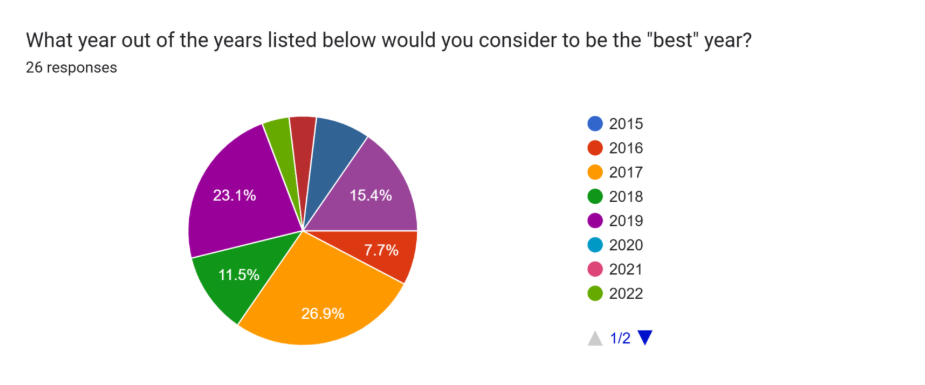
One student said “[Some years can] mark the end of an era, a transition to a new period of growth.” Between the years 2015-2025, students were asked to mark what they considered to be the “best” year. The variety in results shown below helps solidify the fact that, moreover from blanket opinions, what really makes a year good is how it is viewed in retrospect.