


From animal shelters, reputable breeders, or even taking in a stray, there are a plethora of ways to adopt a cat—but one of the most unique experiences to do so is a Cat Cafe.
Cat cafes are cafes where customers are able to interact with cats, which are usually housed in the establishment. While customers enjoy food or beverages, they can pet, play with, and even hold the cats during their experience.
While cat cafes are relatively new in the United States, they have long been well-known and loved in Asia; the idea was first introduced in 1998 in Taipei, Taiwan, with the opening of the then-titled Cat Flower Garden. Japanese tourists visited and fell in love with the concept, spreading the idea, with the first cat cafe in Japan, Neko no Jikan (Cat Time), opening in 2004.
While the United States established the business of cat cafes much later (with the first American cafe, Cat Town Cafe, opening in 2014 in California), their popularity quickly exploded, and, as of December 2025, over 300 are open all over the United States.
While cat cafes may seem like they are just a place to interact with cute cats, in actuality, cat cafes offer many benefits to both cats and humans. Studies show that cortisol, a stress hormone, is decreased as people interact with cats. Along with this, serotonin, dopamine, and oxytocin are increased in humans. These hormones are often considered “feel good hormones.”
Besides the effect on humans, cats also benefit massively from cat cafes. Social interaction helps cats develop, prevents behavioral problems, and builds confidence, as well as reduces fear and sensitivity. Additionally, cat cafes are the perfect experience for potential owners to meet and interact with cats they may want to adopt, as well as explore cat personalities to choose which one is ultimately right for them.
Laura Cassiday, a certified cat behavior consultant and an animal trainer, says, “Cafes can increase a cat’s visibility and may help them get adopted more quickly. They often provide more space and social interaction than a traditional shelter cage.” She importantly adds, “The cats’ wellbeing must come before the customer experience.”
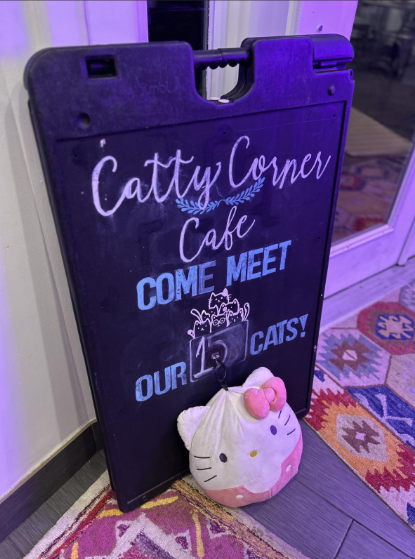
Catty Corner Cafe, which opened in 2022 and is located in Leesburg, Virginia, is a prime example of effective execution of the balance between human experience and cat comfort. Owner and founder, Heather Donahue, combined her love of cozy spaces, coffee, and cats to create a space where customers can enjoy a hot beverage and interact with the cats there. In the case that cats become overwhelmed or stressed, Catty Corner Cafe contains tall cat trees as well as spaces that cats can retreat back to and relax.
“We have a room that they can go into,” said Donahue. “It’s called the escape room…we have that as a nice, cozy place for them to go when they are overwhelmed or just want to sleep without anybody around.”
In relation to this, Cassiday mentions, “Some individual cats are more social and adaptable, but even those cats require predictable quiet periods to fully relax.”
Catty Corner Cafe provides cats a higher chance of getting adopted, whereas in overcrowded shelters, they may be looked over. In terms of crowding, Cassiday mentions that an increased competition for necessities such as food, litter boxes, resting spots, and social space, as well as a limited ability to escape conflict, may cause cats to “withdraw, stay quiet, avoid interaction, or converse energy,” instead of “actively defending resources, setting boundaries, or engaging socially.”
Last Chance Animal Rescue, an animal rescue service that saves animals from high-kill shelters, is partnered with Catty Corner Cafe to help cats find their forever homes in an environment where they can be themselves.
“[The cafe] is an environment… [that is] very relaxed. You can actually see that they like it here, that they’re comfortable, they’re playful, they’re not scared…[people] wouldn’t see that in a shelter…we’re giving these cats a chance to find their forever home,” added Donahue, also mentioning that, in terms of the percent of cats being adopted, they “probably average one a week.”
While cat cafes are largely seen as a beneficial, the controversy of cat cafes center around the idea that a confined space with forced interaction is an unethical stressor for cats. Additionally, the idea of establishments using cats as a business strategy does not sit well for many people.
Cassiday personally believes that cats generally maintain a better wellbeing in a home environment than they do in a cat cafe, saying, “A predictable household with fewer strangers and consistent caregivers allows stress levels to decrease and gives the cat more control over their environment.”
RSPCA, or The Royal Society for the Prevention of Cruelty to Animals, is a United Kingdom Animal Welfare Charity. This organization called for cat cafes to be phased out in March 2025 due to stress, resource competition, restricted space, and health concerns of cats. While the United States hasn’t had as much pushback, there are still some who criticize business practices that may prioritize customer entertainment over cat comfort.
In terms of the call for a phase out, though, many cat cafe owners responded, emphasizing the importance of making a distinction between cat cafes who are purely open for monetary reasons versus those who have an explicit goal of finding a forever home for the cats. Additionally, many owners also stressed the importance of maintaining a high standard of care for the cats living in the establishment.
In addition to this, to combat concerns, many cat cafes have strict rules enforced that visitors must adhere to for the wellbeing of cats. In addition to this, there are many that take precautions regarding the care that goes into cleaning the cat environment, doing health checks, and offering different litter/feeding rooms to give cats as much freedom and relaxation as possible.
“Because illness can spread quickly in places with lots of visitors and cats coming and going, cafes should absolutely require handwashing or sanitizing and shoe covers or shoe removal,” Cassiday says. “They should also be using veterinary-grade cleaners as many generic cleaning products do not kill zoonotic illnesses.”
Proper separation of spaces, constant litter changes, veterinary care, frequent sanitization, and more are all apart of standard protocol for many cat cafes in order to address cleanliness concerns, for example.
In all, Cassiday preaches, “If cafes are going to operate responsibly, they should involve veterinary and behavior professionals when designing the space and setting up management and health protocols and prioritize learning about feline body language and behavior to be able to educate guests. Without these specific things in mind, the welfare of the cats can easily become secondary to human entertainment.”
Though many see cat cafes as a business strategy, it is much more than that. Cat cafes offer unique experiences to meet, play with, and adopt cats, and are overall a benefit to both the cats within and the people exposed to their playful and sweet personalities—all while enjoying a cup of coffee.





![A graphic depicting a young woman looking at herself in a mirror. [Graphic by Mia Miller]](https://phscharge.com/wp-content/uploads/2026/02/Untitled-design.png)
![A photo of the United States Capitol. [Mike Konczewski via Wikimedia, Creative Commons License]](https://phscharge.com/wp-content/uploads/2026/02/maggie-article-pic.png)