


Even after enduring a car accident on the road, the monks kept walking.
Spanning a vast 2,300 miles, the Walk for Peace has captured the media’s attention since October 2025. This group of Buddhist monks have been traveling all the way from Texas on their journey to Washington, D.C.
Their message of inner and social peace is one that has fascinated many Americans. The monks are guided by spiritual leader Bhikkhu Pannakara, who has shared that they walk “to awaken the peace that already lives within each of us,” and that it can “radiate outward to families, communities, and society as a whole.”
The monks began their journey on Oct. 26 from the Huong Dao Vipassana Bhavana Center in Fort Worth, Texas. Alongside the monks is their dog, Aloka, who is an Indian Pariah dog that is accompanying them on their journey. Once a stray, Aloka joined the monks on a previous peace walk in India, staying by their side to this day.
The monks have already passed through Texas, Louisiana, Mississippi, Alabama, Georgia, South Carolina, North Carolina and Virginia. They crossed into Washington, D.C. on the morning of Feb. 10, and plan on returning to Texas on Valentines Day. The group has provided a live map that allows people to track their movements.
Societal Impact
This peace movement isn’t like a traditional protest, but rather it depicts how powerful silence can be. The monk’s hope for unity and peace is very significant, especially in a time of major political tension and division in America. It is meant to bring together communities and people, which is exactly what it’s achieving.
As the monks pass by, people and families are lining the streets. The monks occasionally stop to engage in conversation, or to give someone a blessing.
As part of their beliefs, the monks only carry few items of necessity with them. Additionally, their source of food and nutrition comes from what is offered to them.
Many people have been offering water, food and other resources to the monks. This sort of hospitality shows that movements like The Walk for Peace have a real impact on society.
Michelle Cooper, a history teacher at Patriot High School, speaks about this kindness, “It brings out the good in people, like taking care of your community.”
Overcoming Struggle
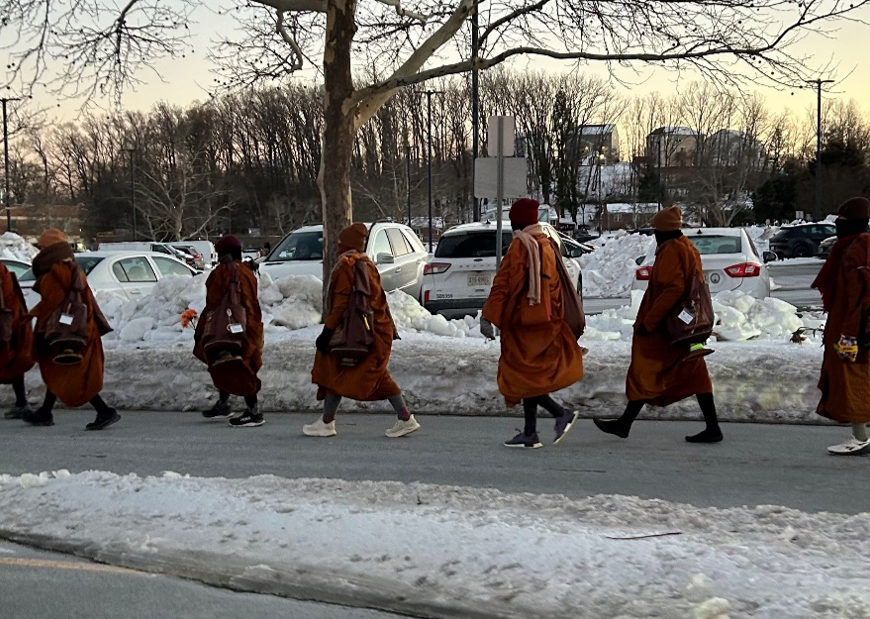
Another aspect of this walk is the monk’s willingness to put themselves in this position and fully commit to the experience. Cooper states, “They’re showcasing a willingness to . . . go through a struggle.”
This is especially portrayed by what the monks have endured. One monk, Bhante Dam Phommasan, was severely injured after a car hit their escort vehicle, which then pushed into the walking monks. Phommasan had to have his leg amputated, but he plans to continue the journey once he is healed.
This perseverance and devotion to their cause, despite struggle, depicts the core principals of Buddhism.
Christina A. Kilby, an Associate Professor of Religion at James Madison University, specializes in Buddhist studies. She states, “Perseverance is also a virtue in Buddhism. . . and patience, not giving up. . . being willing to work hard and keep practicing.”
Additionally, the monks have faced protest against their walk in a handful of states. As they traveled through Walton County, Georgia, a man disrupted them in front of a church. He told the monks, “You have to turn to Christ, he’s the only way,” and insisted that their peace was “false.”
The monks replied calmly without engaging in conflict. “We have our own journey, [and] you have your own journey,” one said. He added, “I wish you well.”
This response highlights the essence of Buddhism and the fundamentals of the monk’s movement. Buddhism is all about mindfulness, helping others, compassion and more. Cooper describes how the religion is “also a belief structure that’s . . . like a philosophy of life . . . It’s all about peace.”
Ending Their Walk
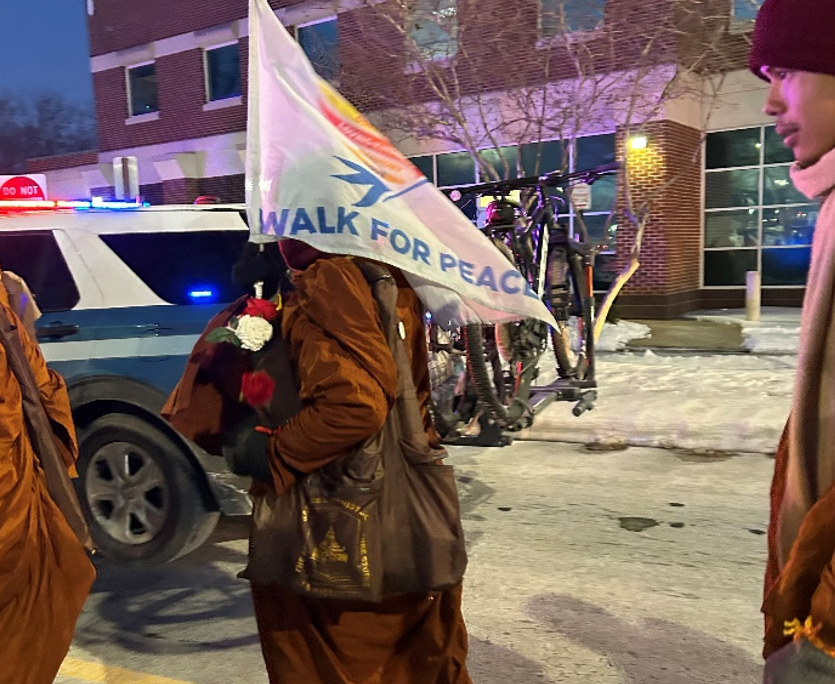
The final destination of the Walk for Peace is at the nation’s capital. This location, as well as the timing of the walk, has a symbolic meaning that ties into the monk’s message of peace. As America continues to be politically divided, the walk highlights how unity is necessary and significant in current times.
Kilby says that in Buddhism, “every action makes a difference . . . especially when they’re motivated by goodwill and compassion.” The Walk for Peace has been efficient in bringing people together and promoting peace, proving that movements like this have important impact.
As the monks end their journey at the capital, they plan on holding peace gatherings where they share messages of healing and unity. Furthermore, they intend to ask Congress to make Vesak, Buddha’s birthdate and day of enlightenment, a federal holiday. This year, Vesak falls on May 1, 2026.
Overall, The Walk for Peace is a movement that has already inspired millions of people. Their message has touched the hearts of those from many different communities.
Bhikkhu Pannakara says, “My hope is, when this walk ends, the people we met will continue practicing mindfulness and find peace.”



![A picture of a soccer ball on the floor taken on Wednesday, Feb. 11, 2026 [Granaz Nabi Bakhsh]](https://phscharge.com/wp-content/uploads/2026/02/Granaz-Photo.png)